
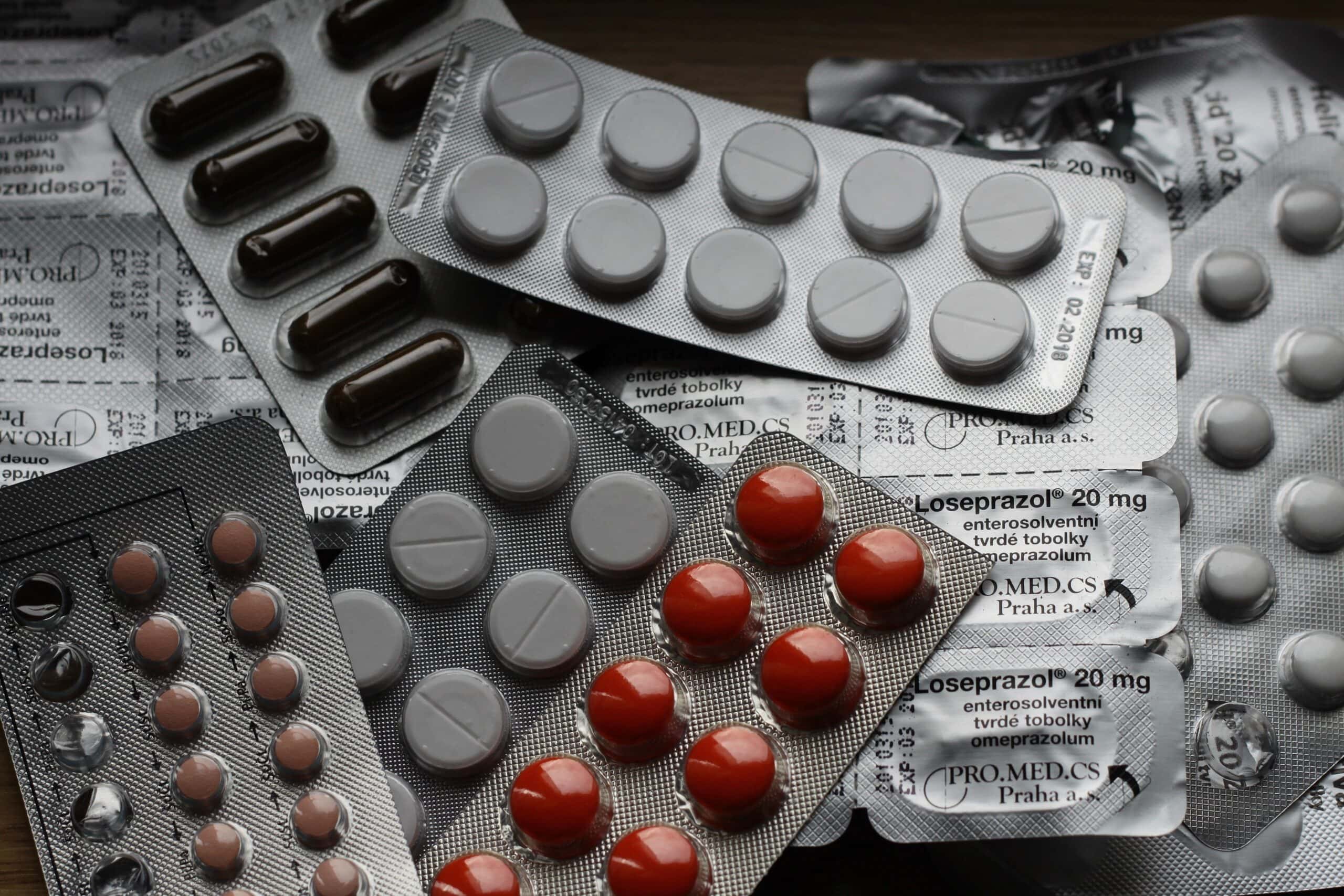
Can you combine microdosing with medication? It’s one of the most frequently asked questions about microdosing — and understandably so. Many people take daily medication, contraceptives, hormones or supplements and want to know what this means if they wish to start microdosing.
Dr James Fadiman and Sophia Korb spent years collecting accounts from people who microdosed independently. This resulted, amongst other things, in a comprehensive list of medicines and supplements that participants used during their microdosing process without reporting any adverse interactions. Their microdosing project aims to collect and share experiences and research data relating to microdosing.
This list is interesting and valuable, but it does need to be interpreted correctly.
Are you new to microdosing? If so, why not read our comprehensive guide on what microdosing is and how it works.
Psilocybin is converted into psilocin in the body and affects, amongst other things, the serotonin system. Medicines can also influence processes in the central nervous system, blood pressure, heart rate or neurotransmitters.
As a result, the effect of a combination can vary depending on the medicine and the individual.
Research into drug interactions with classic psychedelics presents a mixed picture: in some combinations, effects were either reduced or enhanced, whilst in others no clear difference was found. For many specific combinations, there is simply still little human research data available.
That does not automatically mean that microdosing is not possible if you are taking medication. It mainly means that you you should take your specific combination seriously.
Would you also like to know in which situations it’s important to take extra care? Then read when microdosing is not recommended and which contraindications are important.
James Fadiman and Sophia Korb collected accounts from hundreds of people who had microdosed on their own, mainly with LSD or psilocybin.
These compiled experiences included various medicines and supplements that were taken concurrently without any adverse interactions being reported.
The list below is based on that.
Good to know: This list is for information purposes only. If a participant did not report any adverse reactions, this does not automatically mean that the combination has been clinically tested or is safe for everyone.
We treat tramadol separately: If you are taking tramadol, consult a doctor or pharmacist before considering microdosing.
Psilocybin can have an acute effect on, amongst other things, blood pressure. Temporary rises in blood pressure have been observed in clinical trials involving higher doses. Whilst this research does not specifically concern microdosing, it does mean that cardiovascular medication is a category where individual assessment is advisable.
The original collection included, amongst other things:
Among other things:
The original collection included, amongst other things:
Stimulant medication can itself affect, amongst other things, heart rate, blood pressure and the central nervous system. We therefore recommend that, in the case of ADHD-medication: to discuss the specific combination with a doctor or pharmacist beforehand.
Among other things:
The original collection included, amongst other things:
The collection included, amongst other things:
Epilepsy and the medication used to treat it require extra caution. You should therefore not use this checklist as standalone advice on combining psilocybin with anti-epileptic drugs.
Among other things:
This deserves a section of its own, as antidepressants are among the medicines about which there are many questions.
The Fadiman/Korb collection included, amongst other things:
Subsequent research has now provided us with more information about this combination.
Above all SSRIs and SNRIs may reduce the subjective effects of psilocybin in some people. In a retrospective study of people who used psilocybin-containing mushrooms, reduced effects were reported relatively frequently when SSRIs and SNRIs were taken at the same time.
However, that does not mean that anyone should reduce their dose of antidepressants in order to feel the effects of microdosing more strongly.
Never stop taking or reduce your dose of antidepressants on your own in order to microdose.
Are you taking antidepressants and would you like to try microdosing? If so, please discuss this with your healthcare professional or pharmacist.
We would not treat lithium as part of the standard Fadiman list.
There are sufficient indications in the literature of potentially serious interactions with psychedelics to warrant extra caution in this regard. Systematic reviews of interactions between psychedelics and psychiatric medication therefore treat mood stabilisers as a relevant category of interaction.
Do you take lithium? If so, we recommend that you do not start microdosing on your own and to discuss this with your treating doctor first.
The original collection also included various hormonal preparations, including:
Here too, it is important to note that the inclusion of a combination in the Fadiman/Korb dataset means that it was reported by participants — not that each combination has been clinically investigated individually.
Fadiman and Korb also received reports of a large number of supplements being used during microdosing.
These included, for example:
This is interesting because supplements are often part of people’s personal wellness routines.
But the same applies here too: A natural product may be biologically active. Particularly when you are taking several botanical extracts, supplements and medicines at the same time, it is wise to consider the overall combination.
That means, first and foremost, that the remedy was reported in the compiled microdosing experiences of Fadiman and Korb, with no adverse interactions reported.
It does not mean:
“This combination has been proven to be safe.”
And if your medicine isn’t on the list? That doesn’t automatically mean the combination is unsafe either.
The list should therefore be seen primarily as an interesting set of practical data from the development of microdosing research.
This makes individual assessment even more important.
Two medicines may, on their own, give little cause for concern, whereas a combination of different medicines, supplements and psilocybin results in a more complex pharmacological profile.
So, if in doubt, discuss it everything you use with a doctor or pharmacist, and not just the medicine you have the most questions about.
This is perhaps the most important piece of advice on this page.
Never stop, reduce or change your prescribed medication on your own in order to microdose.
This also applies if you read somewhere that a particular medicine may reduce the effects of psilocybin.
The medication has been prescribed for a reason. Microdosing should not be a reason to alter this without medical supervision.
Microdosing is a personal matter. It’s not just your dosage; your health, medication, sleep, stress levels and daily circumstances all form part of that context.
That is why we at Wise Rootz take a relaxed approach:
start low → Fadiman protocol follow → observe → reflect.
For beginners, we recommend starting with 0.5 grams of fresh truffle and the microdosing days according to the Fadiman protocol alternating with two rest days.
If you’re not taking any prescribed medication and would like to know how to start microdosing safely, read our Instructions for Using the Wise Rootz Microdosing Box.
Would you like to learn how to work out your personal amount? Then read on to find out how to work out your the sweet spot for microdosing.
This page provides general, educational information and does not constitute individual medical advice.
Are you taking prescribed medication, do you have a medical or psychiatric condition, or are you unsure about combining substances? If so, please discuss microdosing with your doctor, pharmacist or another qualified healthcare professional beforehand.
Never change or stop taking prescribed medication on your own because of microdosing.
Microdosing is not suitable for everyone. Do not use microdosing products during pregnancy or whilst breastfeeding, or by anyone under the age of 18, or if you have a personal history of psychosis.
Polito V, Liknaitzky P. The emerging science of microdosing: A systematic review of research on low-dose psychedelics (1955–2021) and recommendations for the field. Neuroscience & Biobehavioural Reviews.2022;139:104706. doi:10.1016/j.neubiorev.2022.104706.
A comprehensive systematic review of the scientific research on microdosing, which serves as a useful background to the limitations of our current understanding.
Sarparast A, Thomas K, Malcolm B, Stauffer CS. Drug-drug interactions between psychiatric medicines and MDMA or psilocybin: a systematic review. Psychopharmacology. 2022;239(6):1945–1976. doi:10.1007/s00213-022-06083-y.
A systematic review of potential interactions between psilocybin and psychiatric medication, including antidepressants and mood stabilisers.
Gukasyan N, Griffiths RR, Yaden DB, Antoine DG, Nayak SM. Attenuation of the effects of psilocybin mushrooms during and after the use of SSRI/SNRI antidepressants. Journal of Psychopharmacology. 2023;37(7):707–716. doi:10.1177/02698811231179910.
A retrospective study of psilocybin use among people taking SSRIs or SNRIs. Reduced subjective effects were reported relatively frequently.
Nayak SM, Gukasyan N, Barrett FS, Erowid E, Erowid F, Griffiths RR. Classic Psychedelic Co-administration with Lithium, but Not Lamotrigine, is Associated with Seizures: An Analysis of Online Psychedelic Experience Reports. Pharmacopsychiatry. 2021;54(5):240–245. doi:10.1055/a-1524-2794.
This applies to the section on lithium. Experience reports have indicated that serious reactions, including epileptic seizures, have been reported when lithium is used in combination with traditional psychedelics.
Yerubandi A, et al. Acute Adverse Effects of Therapeutic Doses of Psilocybin: A Systematic Review and Meta-Analysis. JAMA Network Open. 2024;7(4):e245960. doi:10.1001/jamanetworkopen.2024.5960.
Meta-analysis of acute side effects of therapeutic doses of psilocybin. This supports the section in which you state that psilocybin can temporarily affect, amongst other things, blood pressure. Important: this study concerns therapeutic doses and not microdoses.
James Fadiman & Sophia Korb — Microdosing Psychedelics: Medication & Supplement Reports.
Fadiman’s original microdosing project and collection of self-reported experiences with medication and supplements during microdosing. Fadiman J. & Korb S. — Microdosing Psychedelics.
We use cookies to ensure the website works properly, to analyse its use and – with your consent – to improve content and marketing.