

You’re sitting at your laptop with one clear goal in mind. You want to finish something.
Then an email pops up. You take a quick look. You reply to a message. You quickly open another tab. And when you go back to what you were doing, you realise you have to get back into the swing of things.
Does this sound familiar?
We often think of focus as if it were a switch we can flick on. But attention doesn’t work like that. Even without notifications or other distractions, it doesn’t stay in the same place all the time.
It shifts between what’s happening around you, what you’re doing and what’s going through your own mind.
Focus is therefore perhaps less about holding on to attention — and more about understanding how attention moves.
What we do in everyday life focus From a scientific point of view, what we call … consists of various attention processes.
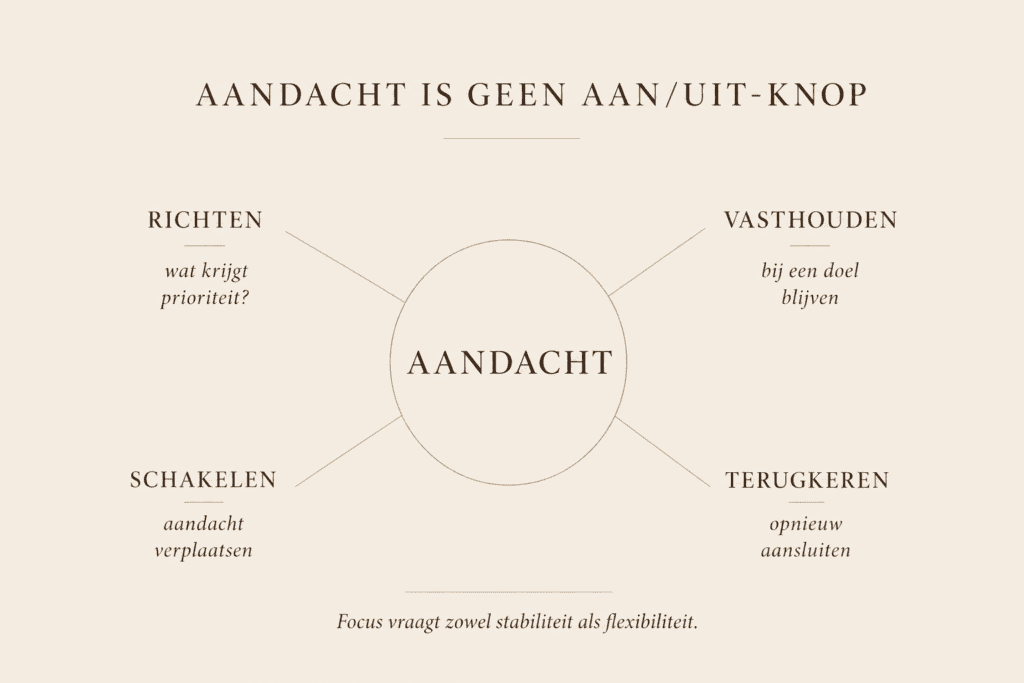
You need to be able to select relevant information and temporarily set other information aside. Sometimes you need to keep your focus on the same task for a longer period of time. At other times, you need to be able to adapt quickly when the situation changes.
Those two qualities seem to be opposites, but we need both of them.
Among other things, researchers discuss cognitive stability: the ability to stay focused on a goal, and cognitive flexibility: the ability to change strategy or task when necessary.
So, good focus doesn’t mean that your attention never shifts.
In this context, ‘attention’ is something different from neuroplasticity: the brain’s ability to adapt through experience and learning.
It means that she can be both stable and flexible at the right moment.
It’s tempting to blame our phones, emails and notifications for a lack of focus.
They can certainly interrupt us. But even in a quiet room without a telephone, our attention doesn’t remain constant.
In research into sustained attention — maintaining sustained attention over a longer period — scientists have observed that performance can fluctuate during a task. Furthermore, in the case of prolonged attention tasks, performance may decline, a phenomenon that is often referred to as the decrease in vigilance is mentioned.
Exactly why this happens is still the subject of research. Motivation, workload, cognitive control and mind-wandering all appear to play a role.
That is why there is no scientific rule stating, for example, that you can concentrate for exactly 20, 45 or 90 minutes.
Attention is not a timer that runs out after a set number of minutes.
You’re reading a page and suddenly realise you’ve no idea what was in the last paragraph.
Your eyes scanned the words, but at the same time you were thinking about this evening, a conversation you’d had yesterday or something you still had to sort out.
That is what researchers call mind-wandering: your attention shifts from the task you are working on to thoughts arising in your mind.
And that isn’t necessarily a sign that you have trouble concentrating.
Mind-wandering is common and appears to be part of how our attention normally functions. Whilst it can be disruptive whilst carrying out a task, internal thinking can also be linked to, for example, planning for the future and reflection.
The aim, therefore, need not be to never stray from the path.
What’s more interesting is what happens when your attention drifts elsewhere — and how easily you return to it afterwards.
In ADHD, attention regulation and distractibility can play a different role. In our in-depth look at microdosing and ADHD bWe’ll take a closer look at what the research on this subject reveals.
As well as letting our minds wander spontaneously, there is another way in which we constantly shift our attention: we swap roles.
Writing.
Email.
Back to writing.
WhatsApp.
Writing again.
Research into task switching shows that such a switch can entail cognitive costs. In experiments, when people switch tasks or change the rules of a task, they generally respond more slowly and/or make more mistakes than when they continue to perform the same task.
When such a change occurs, other task rules and information must be prioritised once again.
That doesn’t mean that adapting is a bad thing. In fact, being able to adapt flexibly is essential.
But Changing gears unnecessarily often is not the same as being flexible when the situation calls for it.
There is also another interesting phenomenon to consider.
Researcher Sophie Leroy introduced the term for this attention residue.
When we stop one task and move on to the next, our attention may still be partially focused on what we were doing before. Leroy’s research suggests that this is particularly likely to happen when we switch tasks whilst our attention is still focused on the previous task.
So you’re back working on your document, but you’re still thinking about that email.
Or perhaps you’re cooking, whilst in your mind you’re still finishing that conversation at work.
That raises the question “What am I doing?” suddenly more interesting.
Because just because you’re physically doing one task doesn’t automatically mean that all your attention is on it.

If attention naturally fluctuates, wanders and has to switch focus, a lack of focus is not automatically a lack of discipline.
You can also help her by changing the circumstances in which she has to function.
Instead of responding to every stimulus immediately, you can make your transitions more deliberate. Finish whatever you can, make a note of where you left off when you have to stop, and group together small tasks such as emails wherever possible. That way, your attention won’t have to switch context unexpectedly as often.
That can be surprisingly simple.
Not every incoming stimulus needs to immediately become a new task. Consciously completing a task or setting it aside can make the transition to the next task clearer. Longer periods without unnecessary interruptions reduce the number of times you have to switch tasks.
Also sleep, and recovery following periods of stress and strain These factors matter, as does the environment in which you’re trying to focus. After all, your attention isn’t separate from the rest of your body.
But perhaps the most important change is the way we view focus.
Not as something you have to keep up at full intensity all day long.
But as a dynamic process of aim, hold, release, change gear and return.
Sometimes it helps to consciously set aside a moment when you want to concentrate on your work: make your surroundings quieter, minimise distractions and choose a single task. For those who incorporate botanicals into such a daily ritual, we have developed Focus Force as part of a deliberate moment of reflection.
We live in an environment where something is constantly demanding our attention.
Greater focus does not, therefore, necessarily mean that you have to train yourself to remain concentrated for hours on end without a break.
Perhaps it starts more with noticing where your attention goes.
Which interruptions are really necessary? When do you lose focus? Which tasks keep popping into your head? And how many times a day do you ask your brain to switch gears?
Good concentration doesn’t mean your attention never wanders.
Perhaps focus is, in fact, the ability to keep returning, time and again, to what really matters.
Live better. Live longer.
Wondering why certain botanicals are being studied in relation to cognitive functions? Read our in-depth article on Ginkgo biloba, focus and cognitive function.
Disclaimer
This information is intended solely for educational purposes and does not constitute medical advice. Persistent or severe concentration problems can have various causes. Discuss any symptoms that affect your day-to-day functioning with a qualified healthcare professional.
Understanding vigilance and its decline (2025). Review article.
Leroy, S. (2009). Organizational Behavior and Human Decision Processes, 109(2), 168–181.
Egner, T. (2023). Nature Reviews Psychology, 2, 702–714.
Vandierendonck, A. et al. (2010). Psychological Bulletin, 136(4), 601–626.
Kawashima, I. et al. (2023). Scientific Reports, 13, 2873.