

Sleep may seem like the most passive part of your day. You turn off the light, close your eyes, and hours later a new morning begins.
But whilst you’re asleep, your body is anything but switched off.
Your brain goes through various stages of sleep; your biological clock regulates the rhythm of day and night; and processes relating to memory, metabolism, immune function and recovery are closely linked to sleep.
A good night’s sleep is therefore about more than simply spending eight hours in bed.
How well you sleep is determined by a combination of sleep duration, quality, timing and regularity.
And that is precisely why sleeping better starts with understanding how sleep actually works.
We spend about a third of our lives sleeping. That alone shows just how essential sleep is for our bodies.
During the night, your brain activity, heart rate, breathing and body temperature, amongst other things, change. Hormones and processes involved in learning, memory, metabolism and immune function also follow their own night-time patterns.
This makes sleep one of the key elements that recur when we look at healthy ageing and healthspan.
Sleep is therefore not a period during which the body simply does nothing.
It is a other biological condition, each with its own rhythm and function.
And that situation changes during the night.
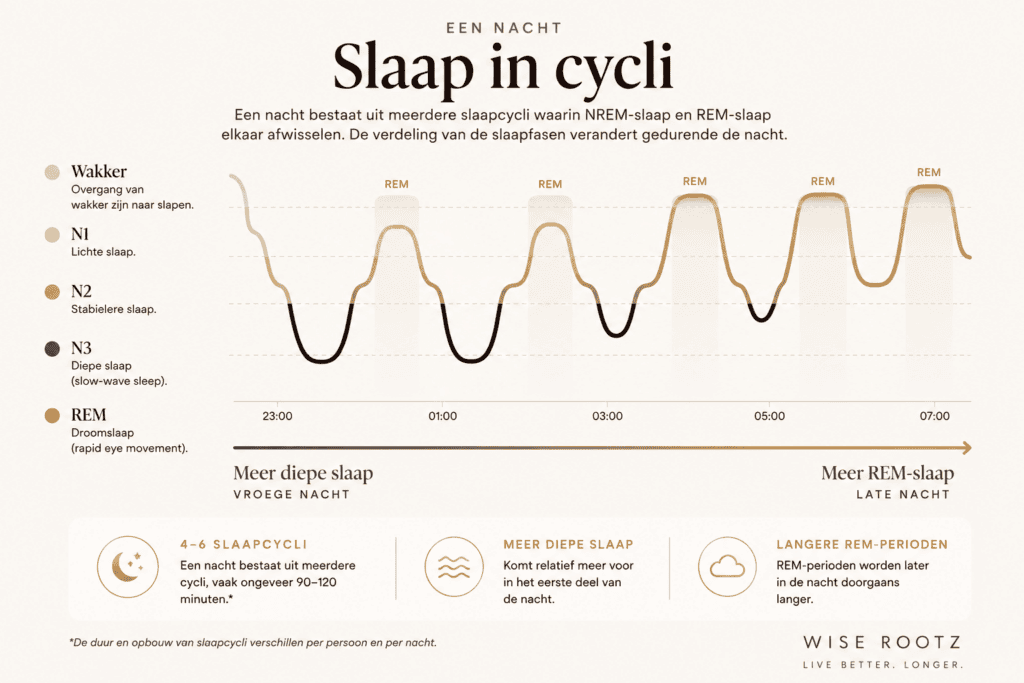
A night consists of several sleep cycles in which NREM sleep and REM sleep take turns.
NREM is divided into three stages:
N1 — light sleep
The transition from being awake to falling asleep. Your muscles relax and your brain activity changes.
N2 — more restful sleep
You are less responsive to your surroundings. Characteristic patterns of activity appear in the brain, which are being studied in relation to, amongst other things, memory and information processing.
N3 — deep sleep
Also known as slow-wave sleep. Brain activity is characterised by slow waves and you are in a state of deep sleep.
After that, you can REM sleep follow: rapid eye movement sleep. Brain activity increases again and vivid dreams are relatively common during this phase.
During a normal night, we cycle through these stages several times. At the start of the night, we experience a relatively higher proportion of deep NREM sleep, whilst periods of REM sleep generally become longer as the night progresses.
A good night’s sleep is therefore not a uniform state lasting eight hours.
It is a carefully organised cycle of different sleep stages.
Wearables have made our sleep stages visible. Every morning, we can see how much deep sleep and REM sleep our watch thinks it has recorded.
That might be interesting, but it could also give the impression that we need to optimise our sleep stages.
Biologically speaking, it’s not quite that simple.
Each sleep stage has its own characteristics and functions. Furthermore, the proportions change over the course of a person’s life and vary from night to night.
What’s more, consumer wearables track sleep stages treasures based on factors such as movement and heart rate, for example. That is not the same as measuring brain activity in a sleep laboratory.
It is therefore better to look at patterns over a longer period rather than at a single ‘perfect’ sleep score.
During sleep, the way in which different areas of the brain are active and communicate with one another changes.
An important area of research is memory consolidation. Information that we take in during the day can be reactivated and consolidated whilst we sleep. Different stages of sleep appear to play different roles in this process.
Emotional processing is also being studied in relation to sleep.
In addition, there is growing interest in the glymphatic system: a system involved in the transport of fluids and the elimination of certain substances in the central nervous system.
Experimental research shows that these processes are linked to sleep and wakefulness.
That is why you sometimes hear that your brain is ‘cleaned’ whilst you sleep. It is an appealing metaphor, but scientifically too simplistic. Moreover, much of the mechanistic understanding comes from animal research.
What the research makes particularly clear is:
Even when you’re asleep, your brain remains biologically active.
Why is it that at some times you can hardly be kept awake, whilst at other times you find it difficult to fall asleep?
Broadly speaking, there are two systems at work here.
The first thing is sleepiness. The longer you stay awake, the greater your need for sleep usually becomes. The neurotransmitter adenosine, amongst other factors, plays a role in this.
In addition, we have circadian rhythm: the body’s internal biological clock, which operates on a cycle of approximately 24 hours.
A central biological clock in the brain helps to synchronise all sorts of processes with the rhythm of day and night. Light is one of the most important signals for this.
Also melatonin plays a role in this. As it gets darker in the evening, natural melatonin production normally increases.
Melatonin is often referred to as the sleep hormone … is referred to as, but it actually functions more like a time signal for the body.
That explains why sleep doesn’t just depend on how tired you are.
Timing matters.

When we’re having trouble sleeping, we often focus on the hour before bed.
But your next night actually begins as soon as you wake up in the morning.
Daylight helps your body clock synchronise with your surroundings.
Exercise is also relevant. Research shows that regular physical activity can support various aspects of sleep quality.
And also regularity deserves attention.
Getting up and going to bed at roughly the same time every day helps to keep your sleep-wake cycle predictable. Research into sleep regularity suggests that it is not only the amount of sleep, but also its regularity, that is important for health and well-being.
That makes sleep much more than just a night-time activity.
Your morning, afternoon and evening all work together to set the stage for your next night.
Some habits affect our sleep, even though we don’t always realise it straight away.
Caffeine temporarily blocks adenosine receptors and can therefore reduce feelings of drowsiness.
What’s more, the effect may last longer than the stimulating sensation you experience yourself.
A systematic review and meta-analysis found that, on average, caffeine was associated with a reduction in total sleep time, lower sleep efficiency and less deep sleep. The extent to which individuals are affected by this varies considerably.
Anyone who has trouble sleeping should therefore not just look at how much the amount of caffeine he or she consumes, but above all to when.
Alcohol can make you feel sleepy more quickly.
But falling asleep and sleeping well are not the same thing.
Alcohol affects normal sleep architecture and can contribute to less stable sleep later in the night.
A nightcap can therefore make you feel drowsy without necessarily leading to a better night’s sleep.
And then there’s that familiar situation: you’ve been tired all day, but the moment your head hits the pillow, your brain suddenly starts thinking about everything.
Stress, alertness and worrying can make it harder to drift off to sleep peacefully.
This can then be compounded by sleep-related stress:
I need to go to sleep now.
Only six hours to go.
I’ll be exhausted tomorrow.
It is precisely this quest for perfect sleep that can therefore cause additional restlessness.
Not every night has to be perfect.
When we apply science to everyday life, the basic principles are surprisingly simple.
Try to get some daylight in the morning.
Light provides your body clock with important information about the time of day.
Make sure you exercise regularly.
Regular exercise can also help improve the quality of sleep.
Try to maintain some sort of routine in your days.
Try not to let your sleeping and waking times vary too much from day to day.
Take a look at your caffeine moment.
If you’re sensitive to caffeine, having your last cup a bit earlier can make all the difference.
Make the transition to night-time a little more peaceful.
Less bright light, work and mental stimulation can create a clearer distinction between day and night.
Make your bedroom a place conducive to sleep.
A dark, quiet and comfortable environment helps ensure a peaceful night’s sleep.
And perhaps most importantly:
Look for patterns, not perfection.
A single bad night’s sleep says little about your sleep as a whole.
At Wise Rootz, we love rituals.
Not because a ritual magically lulls your body to sleep, but because repetition can help to create a moment of transition.
A hot shower. Dimming the lights. Reading a few pages. Some soothing music. Putting your phone away. A cup of decaffeinated tea.
The specific ritual doesn’t have to be perfect.
The value also lies in the moment you use it to highlight something:
The busy day is over.
Self-care doesn’t have to become yet another list of things you’re expected to do properly. On the contrary, it can be a way of consciously making space for rest and recovery.
For those who like to incorporate botanicals into such an evening, we have developed Sleep Deep as part of a mindful evening routine.

There is no such thing as a perfect night that we have to recreate every single day.
Sleep changes with age, life stage, stress, health and environment. Also during biological ageing alter various processes involved in sleep and recovery.
That is why you cannot reduce sleep quality to a single figure.
Een completer beeld kijkt naar:
Duration — krijg je voldoende gelegenheid om te slapen?
Continuïteit — wordt je slaap vaak onderbroken?
Timing — past je slaap redelijk bij je biologische ritme?
Regelmaat — verschillen je slaap- en waaktijden sterk van dag tot dag?
Functioneren — voel je je overdag meestal voldoende uitgerust en alert?
Dat laatste wordt gemakkelijk vergeten.
We slapen uiteindelijk niet om een perfecte grafiek te produceren. We slapen om wakker te kunnen leven.
Beter slapen vraagt niet om de duurste wearable, een perfect avondritueel of een kast vol slaapproducten.
De basis is veel eenvoudiger.
Licht wanneer de dag begint. Beweging. Genoeg gelegenheid om te slapen. Bewust omgaan met cafeïne en alcohol. Ruimte om af te schakelen. En een ritme dat je lichaam enigszins kan herkennen.
Slaap is geen losstaand gezondheidsdoel. Het is verweven met hoe we denken, bewegen, herstellen en functioneren. Precies daarom krijgt slaap ook veel aandacht binnen longevity: niet als losse ‘hack’, maar als onderdeel van de bredere omstandigheden waarin ons lichaam gedurende het leven functioneert.
En juist omdat we iedere nacht opnieuw slapen, krijgen we iedere dag opnieuw de kans om daar goed voor te zorgen.
Niet perfect slapen. Wel beter begrijpen wat jouw slaap ondersteunt.
Live better. Live longer.
Disclaimer
Dit artikel is uitsluitend bedoeld voor educatieve en informatieve doeleinden en is geen medisch advies. Gezondheid en individuele behoeften verschillen per persoon. Raadpleeg bij aanhoudende slaapproblemen, ernstige vermoeidheid of andere gezondheidsvragen een gekwalificeerde zorgprofessional.