


Ginkgo biloba is one of the oldest tree species still in existence in the world. With its characteristic fan-shaped leaves and a history stretching back millions of years, it is no surprise that the tree is often referred to as a living fossil mentioned.
But the ginkgo is more than just an extraordinary tree.
Extracts from the leaves have been used for a long time and are now among the most extensively researched botanical extracts in the field of cognitive function, memory and attention.
Research into standardised Ginkgo extracts has yielded interesting results across various cognitive domains. At the same time, Ginkgo clearly illustrates why, when it comes to botanicals, it is not only the plant itself that is important, but also the extract used, its standardisation and the concentration of characteristic plant compounds.
What makes Ginkgo biloba so interesting? What do we know from research? And why has this botanical been included in both Wise Rootz Focus Force if our Full Focus microdosing box?
Ginkgo biloba belongs to a lineage of plants dating back hundreds of millions of years. Today, Ginkgo biloba is the only surviving species in the Ginkgoaceae family.
The tree originates from China and has a long history of traditional use.
In modern scientific research, the focus is primarily on extracts from the Ginkgo leaf.
These leaves contain various characteristic plant compounds, including flavonoids and terpene lactones such as ginkgolides and bilobalide.
It is precisely this unique chemical composition that has made ginkgo an interesting subject in research into the brain and cognitive function.
Our brains are among the body’s most energy-intensive organs. They rely on a constant supply of oxygen and glucose, as well as on properly functioning biological processes, to process information.
Ginkgo is being studied in relation to various mechanisms.
Ginkgo leaves contain various flavonoids.
These plant compounds are of interest because of their antioxidant properties. Antioxidant processes help protect cells against oxidative stress — an important area of research in brain health and healthy ageing.
A second characteristic group of compounds in Ginkgo consists of terpene lactones, including ginkgolides and bilobalide.
These compounds are characteristic of ginkgo extracts and are being investigated for various biological activities that may be relevant to the nervous system and cognitive processes.
The relationship between ginkgo extracts and blood circulation is also the subject of research.
That is interesting from a cognitive perspective, because the brain depends on a constant supply of oxygen and nutrients.
Together, these various compounds and mechanisms make Ginkgo a particularly interesting botanical in research into cognitive health.
Ginkgo is one of the botanicals that has now been the subject of a considerable amount of clinical research.
A systematic review published in 2023 examined the standardised Ginkgo extract EGb 761 in people with mild neurocognitive disorders. The researchers analysed nine randomised, double-blind, placebo-controlled studies involving a total of 946 participants.
In eight of the nine studies, favourable results were found in neuropsychological tests.
Significant effects were reported across various cognitive domains, including:
This makes Ginkgo particularly interesting from a cognitive perspective.
A comprehensive overview of systematic reviews from 2025 also examined the research into EGb 761. Particularly in the field of neurocognitive disorders, a large proportion of the included reviews reported positive results for cognitive outcomes.
Moreover, research into ginkgo continues to advance. This makes ginkgo a botanical with an exceptionally rich scientific history.

Most clinical research into ginkgo focuses on people with cognitive symptoms or neurocognitive disorders.
Yet it is precisely the areas examined — attention, memory, information processing and executive functions — this is interesting when we take a broader view of cognitive performance.
You can read more about how attention works — from cognitive stability to mind-wandering and switching between tasks — in our in-depth feature on focus and attention.
One detail is essential here:
Ginkgo biloba is not necessarily the same as every Ginkgo biloba extract.
A simple powder made from ground leaves and a precisely standardised extract are two different products.
And that, in fact, brings us to an important aspect of how we at Wise Rootz view botanicals.
When reading scientific research on botanicals, it is important to look at which extract has actually been studied.
With Ginkgo, you might want to look out for the following, amongst other things:
A great deal of clinical research into Ginkgo has been carried out using EGb 761, a specifically standardised extract.
That does not mean that this extract alone is interesting. Above all, it shows why extract quality and specifications matter.
When a study uses a particular formulation, you cannot simply apply the results to any random product on which Ginkgo biloba is.
That’s why, at Wise Rootz, we look beyond just the plant’s name.
Not only:
Which botanical do we use?
But above all:
Which extract do we use, and what does it actually contain?
At Wise Rootz, Ginkgo is recommended for times when focus, concentration and mental alertness take centre stage.
That’s why you’ll find this botanical ingredient in two different products: Focus Force and the Full Focus microdosing box.
Focus Force is our botanical tincture, formulated to support focus and mental clarity.
The formula combines Ginkgo biloba with Bacopa monnieri, Lion’s Mane, Gotu Kola and green tea extract.
In doing so, we bring together various botanicals and functional mushrooms, each of which, due to its own background and characteristic constituents, is of interest within the broader field of cognition and attention.
The result is not a collection of random ingredients, but a formula designed with a single, clear purpose in mind:
to consciously focus on concentration and mental alertness.
You can use Focus Force on its own or as part of a daily routine, for example alongside cocoa.
Discover Focus Force by Wise Rootz
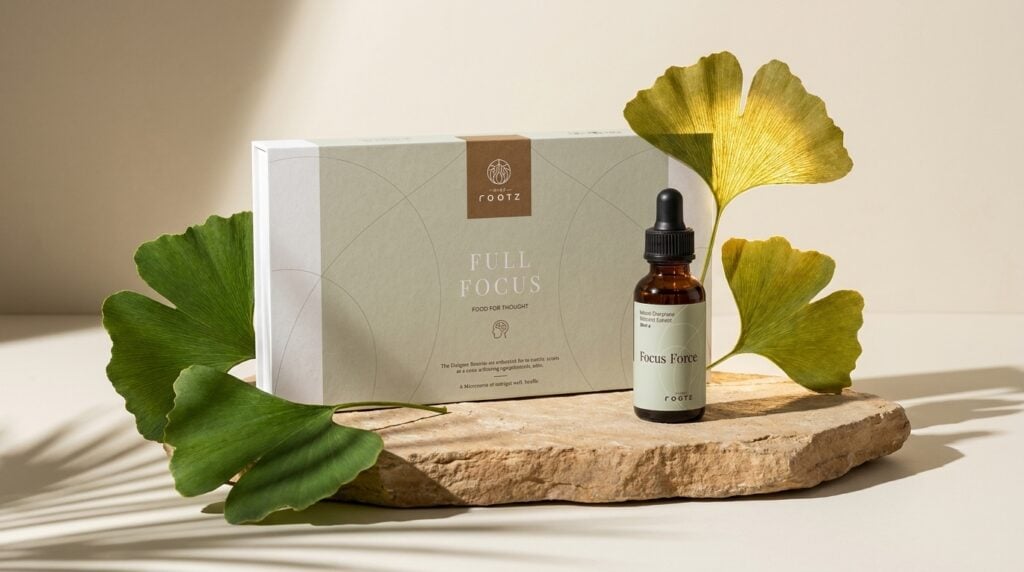
Ginkgo also has a place within Full Focus, our microdosing box, which combines microdosing with carefully selected botanicals, cocoa and guidance via the Wise Rootz app.
That’s where Ginkgo takes on a different context.
Not as a standalone botanical, but as part of a complete experience in which focus, attention, intention and reflectionmeet.
Through the app, you can keep track of your dosage, check-ins and personal experiences, amongst other things, throughout the process.
That’s in line with how we approach things at Wise Rootz microdosing watch:
Measure. Observe. Reflect.
Focusing not just on the microdose itself, but on the whole process surrounding it.
Discover the Full Focus microdosing box.
The fact that Ginkgo features in both Focus Force and Full Focus clearly illustrates how the Wise Rootz collection is structured.
Would you like to incorporate botanical extracts into your daily routine? If so, Focus Force a combination of ginkgo with other carefully selected botanicals and functional mushrooms.
Would you like to use Ginkgo as part of a guided microdosing process in which focus, intention and conscious observation take centre stage? In that case, Ginkgo will take on a different role within Full Focus.
The same botanical.
Two different applications.
And in both cases, the quality of the ingredients used is paramount.
Ginkgo contains biologically active plant compounds. That is why responsible use is essential when taking a high-quality botanical supplement.
It is particularly important to consult a doctor or pharmacist beforehand if you are taking medicines that affect blood clotting. The same applies if you have a medical condition or if you are due to have an operation.
In addition, always follow the recommended dosage and instructions for use for the specific product.
Ginkgo biloba is a wonderful example of where nature, history and modern science meet up.
A tree whose evolutionary history stretches back hundreds of millions of years is now at the heart of clinical research into various aspects of cognitive function.
Research into standardised extracts has yielded interesting results in areas including, amongst others, memory, attention, processing speed and executive functions.
For Wise Rootz, it is precisely that combination that is of interest.
We examine the botanical source, the characteristic constituents, the available research and the quality of the extract before an ingredient is included in a formula.
That’s why you’ll find Ginkgo in Focus Force and Full Focus — two different ways of incorporating this special botanical element into a mindful ritual.
Discover Focus Force or Discover the Full Focus microdosing process.
This information is intended solely for general and educational purposes and does not constitute medical advice. The studies discussed relate to specific Ginkgo extracts, dosages and study populations. The results cannot therefore be applied indiscriminately to every Ginkgo product.
Dietary supplements are not a substitute for a varied and balanced diet and a healthy lifestyle. Always adhere to the recommended daily intake and the instructions for use on the label. Are you taking any medication, particularly blood thinners or antiplatelet agents? Do you have a medical condition? Are you pregnant or breastfeeding? Or are you due to have an operation? If so, please consult a doctor or pharmacist before use.