


We talk about our bodies as if they were mobile phones with surprising frequency.
We’ve run out of energy. Our battery’s flat. We need to recharge.
It’s a handy metaphor. But from a biological point of view, it’s a rather strange one.
Because the feeling “I’ve got no energy” does not automatically mean that your body is literally running out of energy. Fatigue is much more complex. It is an experience that arises from a combination of what is happening inside your body, how your brain perceives this, and what it expects will be demanded of you.
And that might explain something that feels familiar.
How is it that, after a long day at work, you can be too tired to do anything — and then, an hour later, suddenly have the energy for something you’re really looking forward to?
Energy is constantly being produced and used within your cells. Without that energy, muscles cannot move, nerve cells cannot communicate and organs cannot function.
But that’s not the same as the a feeling of being energetic.
Scientists therefore distinguish between different aspects of energy and fatigue: the subjective experience of energy, physical and mental fatigue, and the extent to which physical exertion actually tires a person.
They don’t always run perfectly in sync.
You may feel tired even though you’re still physically capable of doing a lot. Conversely, you may feel mentally sharp even though your body clearly needs to recover.
That doesn’t make fatigue any less real. Above all, it shows that our familiar ‘battery’ model is too simplistic.
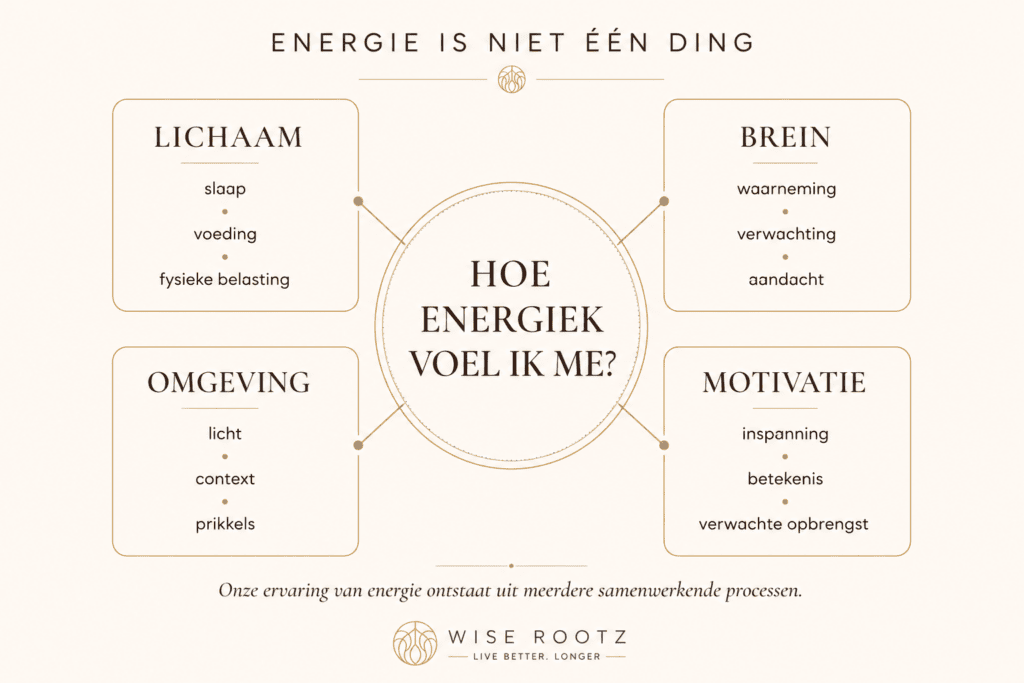
An interesting development in neuroscience is that researchers are increasingly viewing fatigue as part of a control system.
The fact is, your brain doesn’t just react to what’s happening in your body right now. It’s constantly trying to look ahead.
How much effort is something likely to take? What does my environment require of me? What happened last time? And what signals is my body sending me in the meantime?
This ability to anticipate future needs is described in physiology allostasis mentioned. How this constant adaptation relates to stress and recovery, lFind out more at stress and allostatic load.
Recent scientific models are investigating whether our sense of fatigue arises in part from this interplay between physical signals, expectations and the predicted costs of an action.
In 2026, researchers took things a step further with a new theoretical model linking fatigue and our sense of control to the same predictive processes in the brain. Interesting — but still very much a model that requires further empirical investigation.
In other words:
Fatigue isn’t necessarily just a fuel gauge. It can also be part of the way your body tries to regulate stress.
Imagine: it’s six o’clock in the evening.
You’ve been working all day and the very thought of having to go shopping feels like too much.
Then someone rings with a proposal you’ve been looking forward to for weeks.
Suddenly, it seems that energy is coming from somewhere after all.
Of course, your body hasn’t produced a completely new supply of energy in those few seconds.
One of the things that changed was the value of the effort.
Our brain is constantly weighing up the effort involved against the potential reward. Research into effort-based decision-making shows that motivation and the willingness to make an effort are partly linked to brain systems in which dopamine plays an important role.
This brings us to another popular simplification.

Online, dopamine is often described as a sort of combination of happiness, motivation and energy.
It’s not quite that simple.
Dopamine is involved in various processes. Research into motivation shows, amongst other things, that it plays a role in behavioural activation, effort and weighing up whether a potential reward is worth the effort.
That helps to explain why the amount of energy we experienced may also depend on what we want to do.
But that doesn’t mean that tiredness is “all in your head”.
After all, your brain is part of your body.
Just because energy is more complex than a battery doesn’t mean that sleep, diet or exercise are suddenly unimportant.
On the contrary.
Sleepiness, your circadian rhythm, physical exertion, nutritional status, illness, stress and recovery all provide information to which your body must respond.
Have some caffeine.
Caffeine does not literally give your body new energy. One key mechanism of action is the blocking of adenosine receptors. Adenosine plays a role in regulating sleep and wakefulness. As a result, caffeine can temporarily reduce drowsiness and influence alertness — but it is no substitute for sleep.
That difference is important:
Influencing how you feel about your energy levels is not always the same as eliminating your need for recovery.
When we feel tired, we quickly look for something to help us feel to move.
Coffee. A supplement. A cold shower. A better morning routine.
Sometimes, something like that can fit in perfectly with your day.
But perhaps there is a more interesting question:
Why is my body telling me to take it easier at the moment?
Perhaps you haven’t slept well. Your days may have been too hectic for weeks, or you might not be getting enough exercise. Not eating enough could also be a factor. And sometimes you simply aren’t getting the rest you need.
And sometimes there is no simple explanation for one’s lifestyle.
Persistent or unexplained fatigue can have many different physical or psychological causes and therefore warrants medical assessment.
We therefore do not need to view energy as something we must constantly maximise.
Some days we feel sharp and driven. On other days, the same tasks suddenly seem to take more effort.
Our bodies are not machines that wake up every morning with exactly the same capacity.
Perhaps that is precisely what makes energy so interesting.
Not only:
How can I get more?
But also:
What is my body trying to tell me about what is being asked of me today?
If you look at energy in this way, you don’t need to be constantly on the lookout for the next boost.
Sometimes exercise is what you need. Other times, it’s daylight, food or sleep. Sometimes it’s enthusiasm that gets you moving again.
And sometimes, it’s just a matter of recovery.
It is precisely this interplay between daily routines, recovery and functioning that is also central to healthspan.
Sometimes you’re not looking for a substitute for sleep or recovery, but for something that suits an active part of your day. With that in mind, we developed Energy Extra as a botanical formula within the daily Wise Rootz routine.
Read more: Wondering why Cordyceps is often studied in relation to energy and sport? Read what the science has to say about Cordyceps, energy and performance.
Live better. Live longer.
This article is intended solely for educational and informational purposes and does not constitute medical advice. Energy levels and fatigue are influenced by a variety of physical, psychological and environmental factors. Persistent, severe or unexplained fatigue may have a medical cause. If you have any health concerns, please consult a qualified healthcare professional.